

Metal Woven Mesh Animal Cage Net: The Optimal Choice for Modern Zoo

Animals Cage Mesh Order Shipped to Canada
06/26/2026
Stainless Steel Parrot Cage Netting Order Shipping
07/09/2026What is Stainless Steel Metal Woven Mesh Animal Cage Net?
Stainless steel metal woven mesh animal cage net is diamond-shaped mesh panels woven from stainless steel wire ropes. Such panels are specially used as fencing for animal enclosures in zoos, wildlife parks and aquariums. It differs from common iron wire mesh and welded wire mesh we see in daily life.
Ordinary iron wire mesh is formed by permanently welding iron wires together, which is rigid and prone to rust. In contrast, stainless steel woven mesh adopts wire ropes twisted from multiple strands of stainless steel wires. A single wire rope consists of as many as 49 or even 133 ultra-fine stainless steel filaments. This structure retains the tensile strength of steel wire while delivering the flexibility and elasticity of a rope.
Workers manually weave these wire ropes piece by piece into large mesh sheets. Intersecting joints can be secured by hand tying or locked with metal ferrules. This mesh meets all zoo requirements: excellent compression resistance, effective prevention of animal escape, smooth surface, unobstructed viewing for visitors and rust-free performance.
Material Comparison: 304 vs 316 Stainless Steel
There are two mainstream grades of stainless steel woven animal enclosure mesh: 304 and 316. Grade 304 stainless steel is the most common type, widely applicable to most animal habitats. Its core advantage lies in cost performance, and it performs well in ordinary indoor and outdoor settings. For zoos located in mild climates, or enclosures inside indoor, SS304 material offers the best value for money. It resists rust and deformation, with a service life of over 20 years.
Grade 316 stainless steel incorporates molybdenum on the basis of 304. The molybdenum element greatly enhances the steel’s corrosion resistance. Its strengths stand out remarkably in humid, rainy regions, coastal zoos, or enclosures with persistently high humidity. Boasting superior anti-corrosion properties, it easily withstands corrosive conditions such as salt spray and acid rain.
In short, 304 suits conventional environments with high cost efficiency, while 316 fits harsh environments with superior durability. Both grades are food-grade, non-toxic and harmless to animals, posing no health risks even if animals gnaw or lick the mesh. Material selection mainly depends on the local climate of the zoo and the specific conditions of the enclosures.
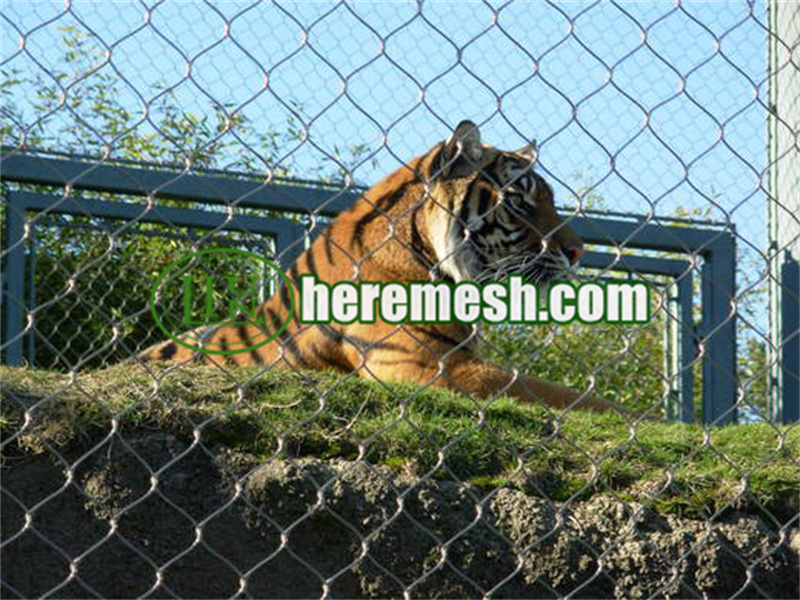
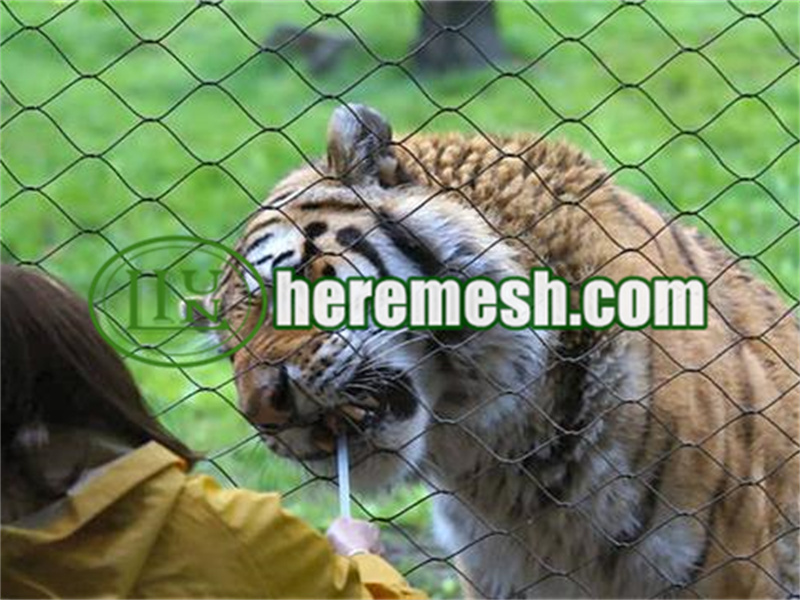
Production Process of Metal Woven Mesh Animal Cage Net
Metal woven mesh animal cage net is divided into two types based on the manufacturing process. Ferrule netting and woven netting. These two types of netting look similar and serve similar purposes, but they are manufactured differently and are suitable for different applications.
Ferrule netting is manufactured by crossing stainless steel wire ropes in a diamond-shaped mesh pattern, then fitting a metal ferrule onto each intersection point and using machinery to press the clips tightly together, securely locking the two intersecting wire ropes in place. Once the ferrules are locked in place, the angle and size of the mesh openings are fixed and will not change.
Ferrule mesh is characterized by its high structural rigidity and a relatively stiff surface. Because each intersection is locked by a metal ferrule, the steel cables cannot slide at the junctions. This means that when the mesh is subjected to an animal’s impact, the force is rapidly transmitted through the rigid joints to the surrounding cables, causing the entire mesh surface to bear the load together and minimizing the risk of localized deformation. For large, powerful predators such as lions, tigers, and bears, the impact resistance of ferrule mesh offers greater peace of mind.
Woven mesh is crafted entirely by hand by workers, without any additional fasteners. Each node is formed by one steel wire rope looping around another to create a knot. The greatest advantage of woven mesh is its flexibility. When an animal collides with it, the mesh surface deforms slightly to absorb the energy and then springs back to its original shape. This cushioning is more animal-friendly, preventing injuries that could result from collisions with rigid fencing.
Another advantage of woven mesh is its smooth surface. The smooth knots do not snag feathers, making it a safer choice for birds. Similarly, for climbing primates such as monkeys and lemurs, the smooth surface of woven mesh prevents abrasions to their palms and soles.
Overall, ferrule mesh has a shorter production cycle and is better suited for large predator exhibits and long, straight fencing spans. Woven mesh is more appropriate for bird enclosures, primate exhibits, and curved or irregularly shaped structures. Many large zoos purchase both types of mesh to use the appropriate one in different exhibit areas.
Flexible Metal Woven Mesh Animal Cage Net — Superior to Conventional Steel Bar Cages
In traditional zoos, the iron bars are thick and densely spaced, severely limiting visitors’ view of the animals. These bars confine animals to a cramped space, an environment that also makes them prone to stereotypical behaviors. Stainless steel metal woven mesh animal cage net fundamentally solve these problems. When viewed from a distance, the stainless steel mesh is completely transparent, allowing visitors to see only the animals and their natural surroundings. Animals looking out from inside the enclosure do not feel the oppressive sensation of being enclosed by iron bars.
Woven metal mesh also offers superior safety. Stainless steel woven mesh is elastic. When an animal collides with it, the mesh first deforms to absorb the impact and then springs back to its original shape. Animals will not be injured, and the mesh will not be damaged. For large animals that like to run, jump, and charge, this elastic protection method is much safer.
Stainless steel woven mesh enclosures are more durable and require virtually no daily maintenance. They do not rust, do not need to be painted, and do not require welding repairs.
The only thing that needs to be done is to occasionally check whether the fasteners have become loose. With virtually zero maintenance required for thirty years, they save on maintenance costs and labor expenses.
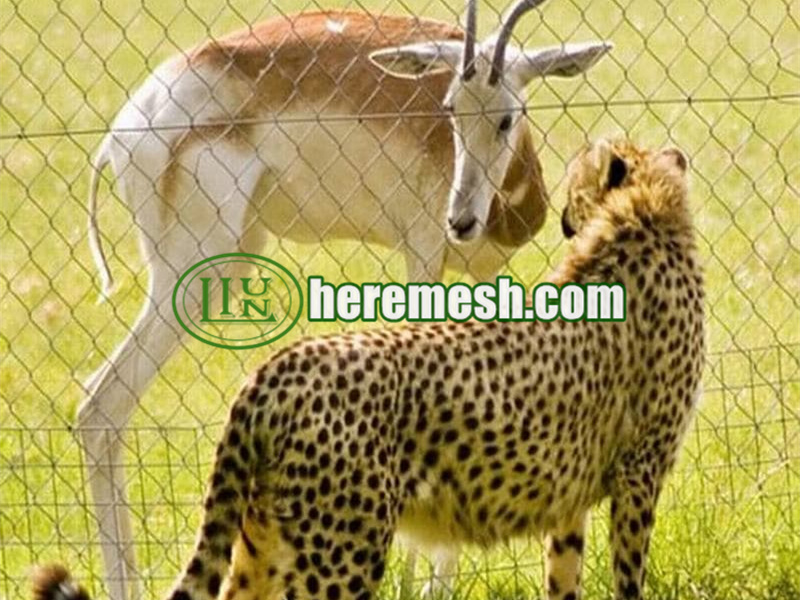
Classification of Application Scenarios for Metal Woven Mesh
Different types of animals have completely different requirements for cage mesh.
Large predators
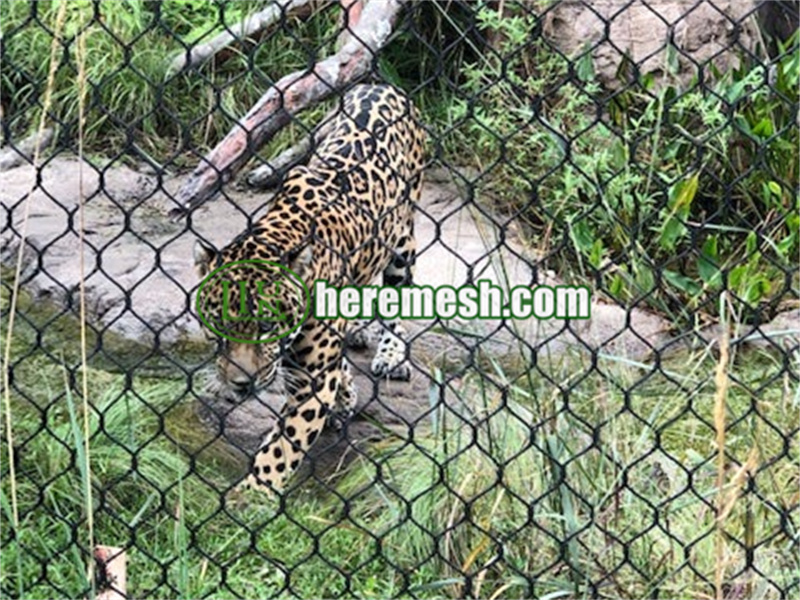
Lions, tigers, leopards, and bears. These animals possess great strength and sharp claws and teeth, and exert the greatest impact force on enclosures of any animal. The striking force of an adult tiger’s forepaw can reach hundreds of kilograms, and a bear’s tearing force is even more astonishing. For big cat exhibits, enclosure strength is the absolute top priority.
Ferrule mesh is typically recommended for big cat exhibits because of its structural rigidity. Each intersection is locked by metal ferrules, allowing it to withstand enormous impact forces without local deformation. The rope diameter is generally selected between 2.4 and 3.2 mm, using a 7×19 steel wire rope construction. This combination of thick rope and a multi-strand structure ensures both extremely high tensile strength and sufficient flexibility to absorb impact. Mesh sizes typically range from 50 to 60 mm; this size prevents predators’ claws from reaching through and injuring visitors while maintaining good visibility for viewing.
When installing netting in predator exhibits, special attention must be paid to the strength of the framework. The fence framework must be constructed from sufficiently thick steel pipes or I-beams, and anchor bolts must be deeply embedded in a concrete foundation. This is because the impact forces absorbed by the netting are transmitted to the framework; if the framework is not sturdy enough, even the best netting will be ineffective.
Primates
Monkeys, gorillas, baboons, and lemurs—these animals are not known for their strength, but their climbing abilities and intelligence are among the highest of any animal.
For primate exhibits, woven mesh is recommended. Woven mesh has a smooth surface without protruding clips, so the palms and soles of primates’ hands and feet will not be abraded while climbing. Mesh size should be selected based on the animal’s body size: for large primates such as gorillas and chimpanzees, the mesh size can range from 50 to 60 mm. For medium-sized primates such as gibbons and macaques, the mesh size should be kept between 38 and 50 mm. For small primates such as marmosets and mouse lemurs, the mesh size must be reduced to 25 to 38 mm; otherwise, they can squeeze through the openings.
Regarding rope diameter, 2.0 to 2.4 mm is recommended for large primates, and 1.6 to 2.0 mm for small and medium-sized primates. Special attention must also be paid to the top covering in primate exhibits—monkeys are expert climbers, and if the top of the enclosure is left open, they can climb up the netting to the top and escape. The junction between the top netting and the side netting is a high-risk area for escape. It must be tightly sewn together with steel wire, leaving no gaps.
Birds
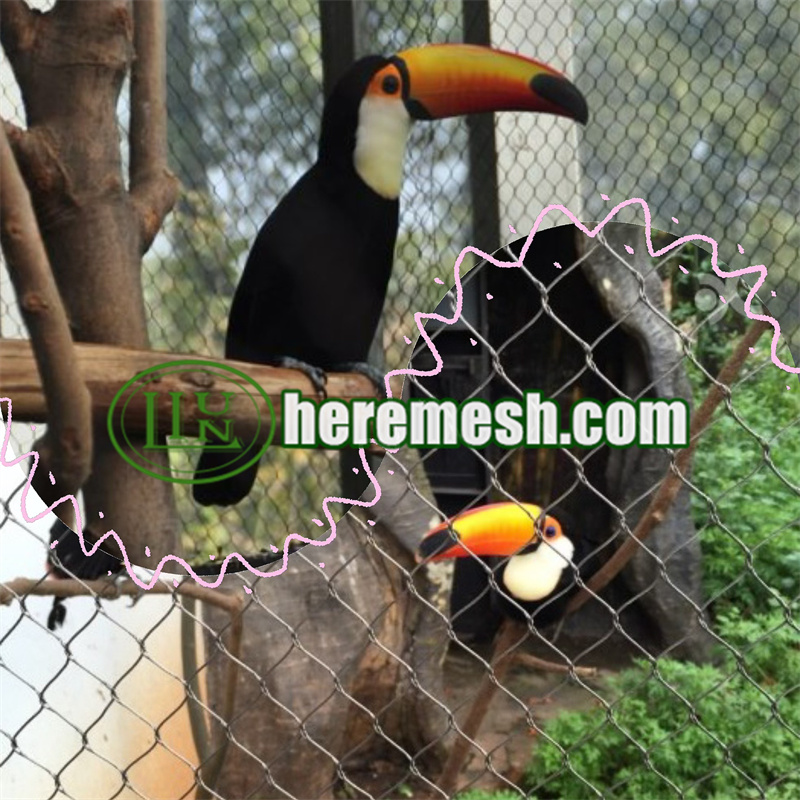
The requirements for birds are different. They are not very strong, but they can fly, and their feathers are very delicate. The primary function of enclosures for birds is not to prevent impact but to prevent escape by flight and to protect their feathers. Woven netting is the best choice for bird enclosures because its surface is smooth and lacks the hard protrusions found on clip-on netting. If a bird comes into contact with the netting while flying, the elasticity and smooth surface of woven netting will not damage its feathers.
The mesh size for bird exhibits depends on the bird’s size. For large parrots, macaws, and hornbills, the mesh size can range from 38 to 50 mm. For small to medium-sized parrots and pigeons, the mesh size should be kept between 25 and 38 mm. For micro-birds such as hummingbirds and finches, the mesh size needs to be reduced to 20 mm.
The rope diameter is generally selected between 1.2 and 1.6 mm. Since birds do not exert significant force, thick ropes are unnecessary. Thinner ropes actually provide better transparency, allowing visitors to view the birds more clearly. Bird exhibits are typically designed as domed or large-span structures, where the height and flexibility of woven netting truly shine in such settings.
Key Points for Installation of Outdoor Enclosure Protection Mesh
The outdoor enclosures at wildlife parks are completely different from the indoor exhibits at urban zoos. Outdoor enclosures are directly exposed to the elements—wind, sun, and rain—and the spans of their fencing are often much larger. When installing protective netting for these enclosures, there are several key points that must be addressed.
Enclosure Foundation Structure
The support posts of an outdoor enclosure serve as the “skeleton” of the entire netting system. The bases of these posts must be set in concrete, with the depth determined by the local frost line. Post spacing is typically maintained between 2.5 and 3 meters. If the spacing is too wide, the netting will sag in the middle, while too narrow a spacing will drive up costs.
Enclosure Frame Materials
Since the frames of outdoor enclosures are exposed to the elements year-round—including wind and rain—the materials used must be corrosion-resistant. Hot-dip galvanized steel pipes or stainless steel pipes are recommended. Hot-dip galvanized steel pipes are less expensive, and their zinc coating provides basic rust protection, making them suitable for dry inland regions. If the zoo is located in a coastal or humid, rainy area, it is best to use 316L stainless steel pipes directly for the frame.
The mesh tension must be uniform
This is the most technically challenging aspect of installation. If the tension is too loose, the metal woven mesh animal cage net will sag. Animals can climb up by stepping on the sagging mesh, and the loose mesh will sway constantly in the wind, accelerating fatigue. If the tension is too tight, the steel cables will be under high stress for extended periods, shortening their fatigue life. The tension across the entire mesh must be uniform; it cannot be tight in some areas and loose in others.
Roof covering for the enclosure
The roof of an outdoor, open-air enclosure is the most easily overlooked area. The junction between the roof netting and the side netting is the most dangerous escape point. When constructing the enclosure, the wire mesh must be tightly sewn together using steel wire ropes, with no gaps larger than the mesh openings. If snow accumulates on the roof mesh, the weight of the snow must also be considered. Mesh openings allow most snow to fall through directly, but if the local snowfall is heavy and the snow is wet and dense, it may be necessary to increase the density of the supports or reduce the mesh size.
These design details directly impact the protective netting itself and are critical to the safety and quality of life of the animals housed in outdoor enclosures. Therefore, when customizing stainless steel metal woven mesh animal cage net, it is essential to carefully control all structural details to create a safe, durable, and well-suited habitat for various animals.