

High Tensile Flexible Stainless Steel Rope Mesh with Sleeves

Shipment of Black Animal Protection Cable Net
09/04/2026
Zoo Mesh Price Guide: Animal Enclosure Selection and Costs
09/18/2026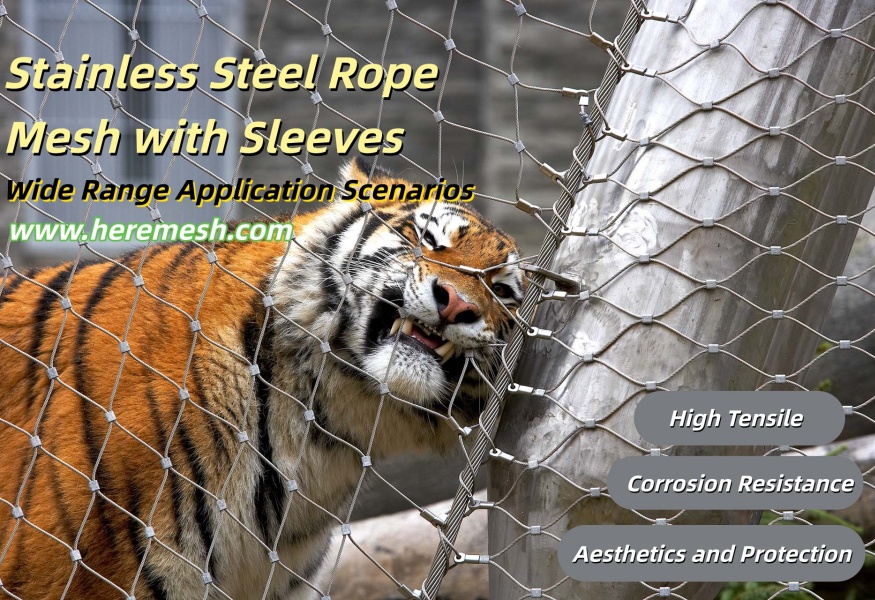
Principle & Structure of Stainless Steel Rope Mesh with Sleeves
Stainless steel rope mesh with sleeves, also known in the industry as ferruled mesh or stainless steel ferrule mesh. Its name clearly describes its structure. Stainless steel wire ropes are arranged in a crisscross pattern to form diamond-shaped mesh openings, with a metal sleeve (a ferrule) fitted at each intersection. Hydraulic equipment is then used to compress the sleeves, firmly locking the two intersecting wire ropes together.
The sleeves are typically made of the same stainless steel as the wire rope. Once crimped, they interlock tightly with the rope, forming a fixed, non-slip rigid joint. The entire mesh consists of a diamond-shaped surface formed by countless such locked joints. Because the joints are locked in place, the angle and size of the mesh openings remain fixed after installation. Ferrule mesh is typically tensioned at a 60-degree diamond angle, with mesh opening calculated based on the diagonal.
The flexibility of ferrule mesh does not refer to the movement of the sleeves themselves, but rather to the fact that the entire mesh is made of a flexible material. It can be transported in rolls, conform to frames, and adapt to various installation shapes. While each sleeve is rigid, the entire mesh can still be bent and laid out. This flexibility is precisely what distinguishes ferrule mesh from other types of netting.
In production, ferrule mesh utilizes machine-assisted processes, with hydraulic equipment used to crimp the sleeves, ensuring high efficiency and consistency. Compared to purely hand-woven mesh, it offers a significant advantage in terms of delivery time.
Core Difference Comparison: Woven Mesh vs Ferrule Mesh
Ferrule mesh and woven mesh are similar in appearance and share overlapping applications, but their underlying differences are quite distinct.
Structurally, ferrule mesh relies on metal sleeves to lock the intersections in place, resulting in hard protrusions at the joints. Woven mesh, on the other hand, is formed by interlacing and knotting steel wires without any additional fasteners, resulting in a completely smooth surface.
In terms of performance, for the same wire rope specifications, the breaking load of ferrule mesh is approximately 6% to 7% higher. This is because the sleeves create a more efficient force transmission path. More importantly, fatigue resistance is superior. The sleeves in ferrule mesh prevent displacement and wear of the wire rope at the intersections, resulting in minimal degradation even after tens of thousands of load cycles—a feature that gives it an advantage over woven mesh.
In terms of feel and appearance, woven mesh is smoother and lighter, offering slightly better visual concealment. Stainless steel rope mesh with sleeves, due to its sleeves, is slightly heavier and has a textured surface.
Regarding flexibility, woven mesh is more elastic and is suitable for curved surfaces such as domes and arches. Ferrule mesh is relatively rigid, with limited adaptability to curved surfaces, making it more suitable for flat or regular shapes.
In terms of production lead time, ferrule mesh is produced and installed quickly, and installation is relatively straightforward—even novice installation crews can handle it. Woven mesh requires entirely manual weaving, resulting in a longer production lead time, and installation requires more experienced workers.
These two types of mesh are not mutually exclusive. They are tools suited for different applications.
Material Selection Guide
Stainless steel rope mesh with sleeves is primarily available in two grades: 304 and 316. The choice between them depends mainly on the intended environment.
304 stainless steel is a general-purpose grade suitable for indoor exhibition halls, areas with dry climates, and typical inland outdoor environments. It offers excellent value for money and can last more than 20 years under normal conditions, making it the top choice for most projects.
316 stainless steel contains added molybdenum compared to 304, significantly enhancing its resistance to chloride ion corrosion and extending its service life to approximately 3 to 5 times that of 304. It is suitable for coastal areas, regions near salt lakes, high-humidity and rainy areas, as well as exhibition spaces with prolonged exposure to water. If a project is located in an environment with high humidity and heavy salt fog, the additional procurement cost will quickly be offset by savings on replacement and maintenance costs.
The decision-making process is straightforward. First, consider the climate and corrosion environment of the project site. For dry inland or indoor settings, choose 304. For coastal, high-humidity, rainy, or water-exposed environments, choose 316. If the budget allows and you’re seeking the longest service life, 316 is the safest choice. Both materials are food-grade and are non-toxic and harmless to animals.
Guide to Mesh Type Selection
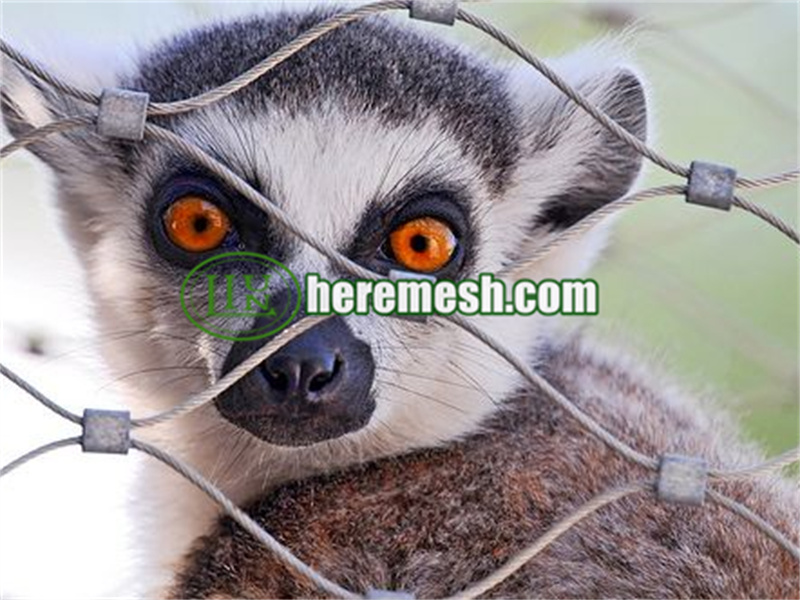
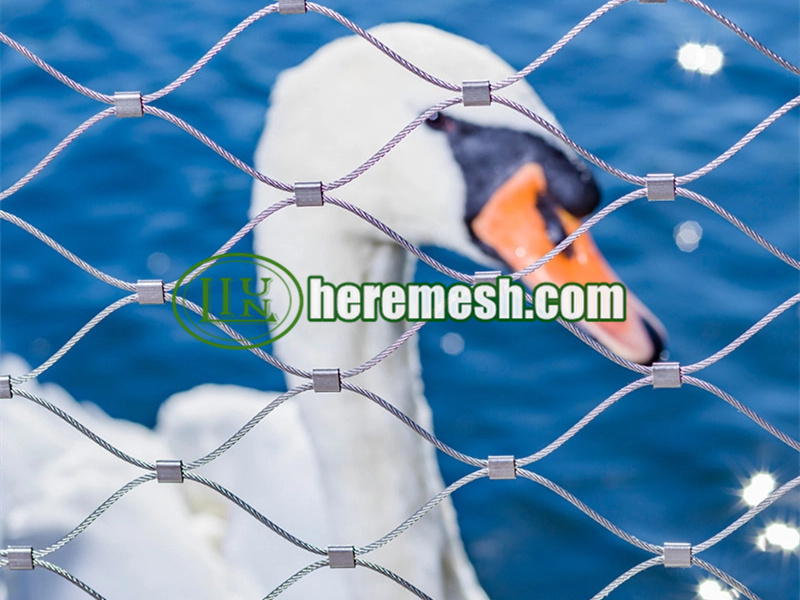
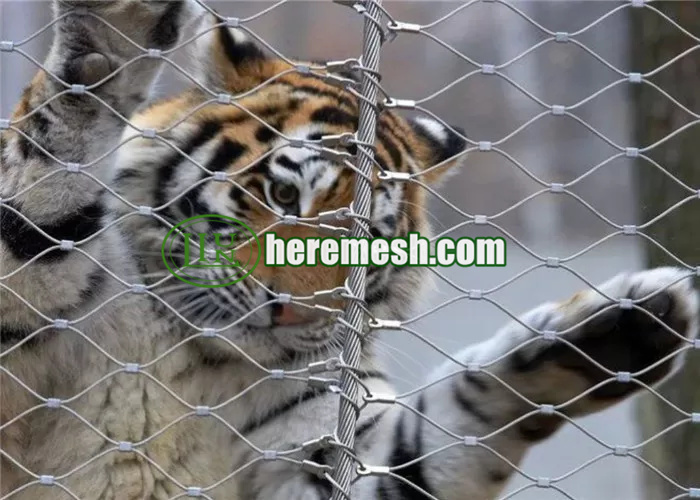
First, let’s look at the types of animals. For large predators (lions, tigers, bears), ferrule mesh is the top choice. Because these animals exert tremendous impact force, they require the impact resistance and dimensional stability provided by rigid nodes. The design principle of ferrule mesh is to “withstand the impact head-on.” Woven mesh, on the other hand, is better suited for primates, climbing animals, and birds. Woven mesh has a smooth surface that won’t abrasively damage the animals’ paws, feet, or feathers, and its elasticity provides cushioning and rebound when animals collide with it.
Next, consider the enclosure design. For large-span straight fences, rectangular enclosures, and flat surfaces, ferrule mesh is perfectly adequate. However, for domed aviaries, curved fences, irregular or non-standard structures, or situations requiring the netting to bend significantly to conform to the surface, the high flexibility of woven mesh is something that ferrule mesh cannot easily replace.
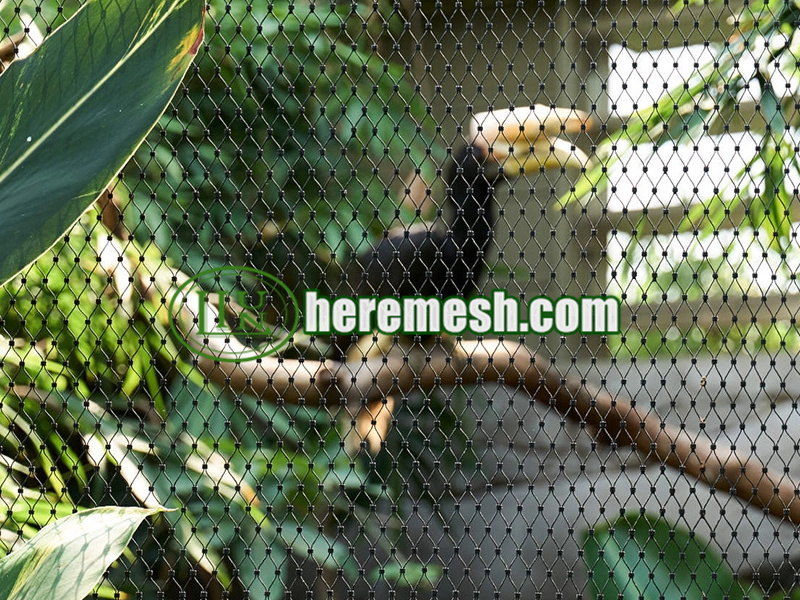
Stainless Steel Wire Rope Mesh with Sleeves Design for Easier Installation
The ease of installation of ferrule mesh is a key reason for its widespread use in actual construction projects.
First is the stability of the mesh openings. Because each intersection is locked in place by a sleeve, the size and angle of the openings do not shift during the tensioning process. Workers do not need to repeatedly adjust the shape of the openings. They simply need to evenly tension and secure the entire sheet, which significantly reduces the need for specialized construction experience. In contrast, if tension is applied unevenly during installation, the mesh openings of woven mesh are prone to distortion, requiring more meticulous adjustments.
Second is its structural integrity. Ferrule mesh is highly rigid. Once unfolded, it does not curl at the edges or form knots, and can be easily laid out by just two people. The mesh surface remains taut, so the edges do not shrink back when secured to the frame, making edge finishing relatively simple.
Third is the speed of installation. The rigid structure ensures precise positioning when the mesh is fitted to the frame. Combined with standardized edge fasteners and tensioning devices, installation efficiency is higher than that of woven mesh. For projects with tight deadlines and large areas, this can result in significant savings on labor costs.
Corrosion Resistance, Aesthetics and Protection
Ferrule mesh offers comprehensive solutions in terms of both protective performance and visual appeal.
In terms of corrosion resistance, stainless steel is inherently rust-resistant. When combined with a black oxide finish, it provides what can be described as double protection. The black oxide process creates an oxide film on the surface of the steel wire rope that fuses with the metal substrate—it is not a post-application paint coating, so it will not peel or fade. This oxide film further enhances resistance to salt spray and humidity, ensuring the product remains stable even after long-term outdoor exposure.
Aesthetically, the matte black finish makes the mesh virtually invisible against natural backdrops. Amid greenery and in shaded environments, the black mesh blends into the background. Visitors barely notice the fence’s presence, and animals are not stressed by metallic reflections. The matte surface does not reflect sunlight, preventing the “glare” issue in bright light.
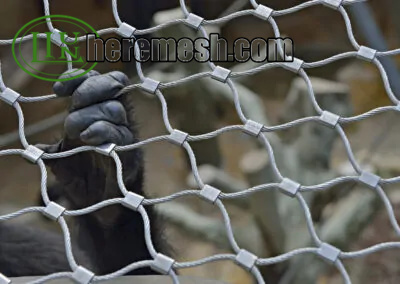
In terms of protection, the interlocking tube structure transforms the entire net into a unified load-bearing system. When an animal collides with it, the impact force is rapidly dispersed along the joints, preventing failure at any single point. Although the joints feature rigid protrusions, they pose absolutely no risk of injury to large animals, as the surface remains smooth and free of burrs.
Application Scenarios
Ferrule mesh has a very wide range of applications, covering virtually all fencing scenarios that require high strength.
Large predator exhibits are the traditional main application for stainless steel rope mesh with sleeves. Animals such as lions, tigers, leopards, bears, and wolves are powerful and deliver strong impacts, requiring the impact resistance and dimensional stability provided by the rigid joints of ferrule mesh. The wire diameter is typically 2.4 to 3.2 mm, with mesh openings ranging from 50 to 76 mm.
Stainless steel rope mesh with sleeves is equally suitable for enclosures housing ungulates. Animals such as deer and antelopes are agile runners with strong ramming force, and this mesh can withstand repeated impacts without deformation.
Protection for zoo building facades and visitor walkways is another common application. With its high rigidity and uniform appearance, ferrule mesh is both safe and aesthetically pleasing when used for building curtain wall decoration, pedestrian bridge safety netting, and boardwalk railings.
This mesh is the preferred choice for high-traffic viewing areas because its structural stability ensures long-term reliability. It is fatigue-resistant and wear-resistant, requiring minimal maintenance.
Furthermore, in civil and engineering applications such as landscape design, villa railings, bridge guardrails, and stadium fencing, ferrule mesh is widely used due to its cost-effectiveness and ease of installation.
Q&A
Q: Can the sleeves on ferrule mesh come loose or fall off?
No. The sleeves are tightly compressed by high-pressure hydraulic equipment, forming a seamless bond with the steel wire rope. They will not come loose or fall off during normal use, nor will they fail due to temperature changes or long-term use.
Q: Is stainless steel rope mesh with sleeves suitable for large animal enclosure?
Yes. Ferrule mesh features high rigidity and good impact resistance to withstand impacts from large animals, ideal for protective fences with flat or regular shapes such as large animal enclosures. For domes and curved structures requiring the mesh to bend heavily for fitting, cable mesh with better flexibility is more suitable.
Q: Will the black oxide treatment fade?
No. The black color is an oxide film formed by a chemical reaction on the surface of the steel wire rope. It is fused with the base material and is not a coating. It will not peel or flake off, nor will it fade even after prolonged exposure to the sun outdoors.
Q: Does outdoor ferrule mesh require maintenance?
Almost none. Stainless steel is inherently rust-resistant. Simply rinse it periodically with clean water to remove surface salt and dirt. No painting or rust-proofing is required. We recommend checking the fasteners annually for looseness.
Q: Can it be customized to my dimensions?
Yes. Ferrule mesh is fully customizable. Rope diameter, mesh aperture, panel dimensions, and surface color can all be produced to order. The entire panel is manufactured to the project’s exact dimensions, avoiding waste from on-site cutting.