

Subtle Details of Crane Aviary: Animal Welfare Design of Crane Netting

Stainless Steel Wire Rope Pheasants Cage Netting
10/23/2026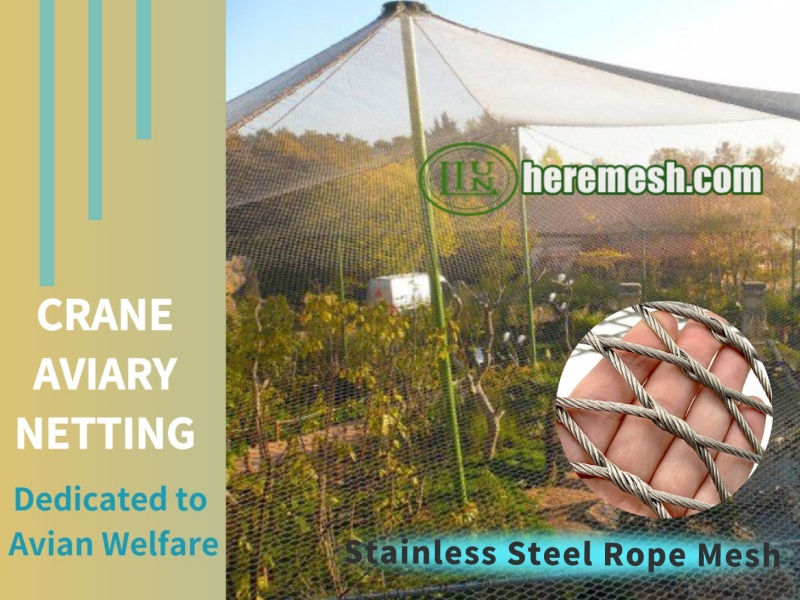
At crane conservation sites like zoos and bird parks, crane netting is vital infrastructure for captive crane habitats. For a long time, many facilities have been guided by a simplistic understanding when constructing crane netting enclosures. They regard the primary purpose of safety netting as preventing escapes, with priority given to strength, cost, and ease of installation. When crane injuries or collisions happen, they often replace netting with thicker, tighter woven material. However, numerous cases have shown that many safety hazards do not come from the strength of the netting material itself. They arise from easily overlooked details such as netting structure and mesh size ratios.
Cranes are large wading birds. Their physical structure and the huge impact force from flight create special enclosure requirements. These requirements differ from those for ordinary birds. With the evolution of animal welfare principles, enclosures are no longer merely barriers for separation. A qualified crane enclosure protection system must cover physical safety, behavioral needs and psychological comfort. It should also minimize stress from human intervention. Stainless steel rope netting is gradually used for crane breeding and exhibition. This design fits modern wildlife husbandry and welfare standards.
Crane Enclosure Accidents: Lies in Netting structure, Not Material
In most cases where cranes are injured, the cause is not breaking through the netting to escape, but rather getting caught, entangled, or sustaining injuries from collisions. Limb entrapment and flight feather snags on wires are the most frequent crane netting injuries. In many instances, the protective netting involved in these incidents still meets the required tensile strength standards. The material itself shows no signs of corrosion or damage; rather, the flaws lie in the overall structural design.
The construction of protective netting involves three core dimensions: netting configuration, tension allowance, and perimeter sealing. Traditional square-hole welded wire mesh has a right-angle structure. When a crane’s claws press down, the corners of the mesh are prone to creating a “bite” effect. Once a toe is inserted at an angle, the more the crane struggles, the tighter it becomes trapped. The tensioning process of the netting is equally critical; installation must allow for space to accommodate buffering deformation. When a startled crane collides with the mesh, the impact force can be absorbed, reducing the likelihood of injury to the animal.
Rope and Mesh Proportion: Smaller Is Not Safer
“The smaller the mesh, the safer it is” is a widespread misconception in crane enclosure design. While this logic applies to small songbirds, when applied to cranes, it actually creates new risks.
Cranes have long, slender beaks and delicate toes. If the mesh size is blindly reduced, the tips of their beaks and toes can easily slip through the netting and become trapped. Conversely, if the mesh openings are too large—exceeding the width of a crane’s head and neck—the head and neck may become caught in the netting. Therefore, the design logic for safe mesh openings involves finding a range that provides protection in both directions: the openings must be smaller than the width of the crane’s head and neck but larger than the size at which the tip of the beak or toes could easily become trapped.
The choice of rope diameter must also be matched to the mesh size. If the rope diameter is too large, the netting becomes stiffer, its weight increases, and its light transmission and sense of openness decrease. If the rope diameter is too thin, repeated impacts over time will cause fatigue, significantly shortening its service life. A well-developed design employs a differentiated ratio. The main body of the net uses a rope of appropriate thin diameter to retain flexibility and cushioning capacity. Thicker ropes are used to reinforce the perimeter edges and column connection points, ensuring overall stability. The rope diameter and mesh aperture are optimally matched.


Woven Rope Netting vs. Traditional Metal Mesh: Toughness Disparities
At present, the metal fencing materials available for crane enclosures can be broadly categorized into three types. Welded wire mesh, diamond-shaped mesh, and stainless steel rope netting. The main differences among them lie in their toughness and compressive strength.
Welded wire mesh relies on welds to secure the intersections. It is inexpensive, has a uniform mesh surface, and is widely used. However, since the welds are rigid connection points, repeated impacts by cranes on these areas can cause the welds to crack. Diamond-shaped mesh offers greater flexibility than welded wire mesh, but since the joints are formed by interlocking twisted wires, localized damage can easily cause the wires to come loose, making repairs difficult.
Stainless steel rope netting features a weld-free design, with the intersections of the twisted stainless steel ropes secured through weaving techniques, allowing for slight movement at the joints. When a crane strikes the netting, the impact force is dispersed across multiple surrounding strands. The netting absorbs the energy through deformation, creating a flexible buffer. This resilience offers multiple benefits. First, it cushions the impact, reducing the risk of injury to birds. Second, damage is localized. A single point of damage requires only a localized repair and does not cause the entire section to fail. The stainless steel strand structure is wear-resistant and age-resistant. In the damp environment of wetlands, its fatigue resistance far exceeds that of welded joints. Ductility is a critical factor that cannot be overlooked when selecting fencing for large wading birds.
No Frequent Replacement: Less Disturbance to Cranes
Animal welfare is not limited to the prevention and control of injury risks. Stress levels and environmental stability are equally important evaluation criteria. Cranes are naturally sensitive, and prolonged, continuous disturbances can lead to a decrease in appetite and an increase in stereotypical behaviors among the flock. Many people tend to overlook the fact that fence maintenance and replacement are, in themselves, forms of high-intensity disturbance.
Stainless steel rope netting made of 316-grade material is resistant to moisture and salt fog corrosion, making it well-suited for the high-humidity environment of wetland crane enclosures. It is resistant to rust and aging even with long-term use. With its long service life, stainless steel crane netting requires only simple routine inspections, significantly reducing the frequency of dismantling, replacement, and large-scale repairs. In contrast, welded wire netting rusts rapidly at the weld points in humid environments, while chain-link fencing is prone to fraying and loose wires, both of which require regular on-site maintenance and replacement. Every large-scale mesh replacement operation requires personnel to enter the enclosure, disrupting the crane flock’s sense of security and stability.
The deeper value of low maintenance lies in minimizing human disturbance. A high-quality protective design aims to ensure long-term environmental stability, allowing the crane flock to grow in a familiar, undisturbed space.


Low Visual Intrusion: Balancing Exhibit Design and Animal Welfare
Modern zoos and avian parks balance two key objectives: public education and animal welfare. Crane netting must strike a balance between the visitor experience and the animals’ well-being, with minimal visual disruption being a critical factor.
From a display perspective, the ideal scenario for educational exhibits is to allow visitors to focus on the cranes themselves and their natural habitat simulations, rather than having their view disrupted by heavy, dense metal fencing. Stainless steel rope netting with fine strands and appropriately sized mesh openings has a low visual presence when viewed from a distance. Its high transparency preserves spatial depth, creating an experience reminiscent of natural wetlands and enhancing the effectiveness of nature education. Coarse, dense, rigid metal mesh, on the other hand, creates a strong sense of isolation and diminishes the immersive effect of the exhibit.
From an animal welfare perspective, enclosed, heavy fencing intensifies the sense of confinement and can trigger stereotypical behaviors. A transparent mesh surface does not create a strong sense of visual confinement. It maintains secure boundaries while letting cranes spread wings, roam and behave naturally. Low‑visibility fencing balances exhibit and welfare needs, reducing visual obstruction and confinement stress.
Conclusion
The evolution of crane enclosure design reflects a shift in wildlife conservation philosophy. Protection is no longer limited to physical isolation but has shifted toward a comprehensive, animal-friendly design. When evaluating the quality of a fencing system, one cannot rely solely on tensile strength parameters and construction costs; one must also examine whether the mesh structure accommodates the cranes’ movement patterns, whether the ratio of mesh aperture to cable diameter minimizes the risk of entanglement, whether the mesh’s flexibility can cushion impacts, whether maintenance procedures cause ongoing stress, and whether the visual design balances animal welfare with educational display needs.These subtle details hidden within the fencing are difficult to perceive at first glance, yet they continuously influence the cranes’ quality of life. The value of stainless steel rope netting lies not in it being a more advanced metal material, but in the design philosophy that integrates animal behavior and psychological well-being into the protection plan. For crane conservation, the best fencing serves not only as a reliable safety barrier but also as an invisible boundary that minimizes disruption to their natural lives.