

Zoo Containment Cable Mesh for Modern Zoo Enclosures: A Complete Guide

Zoo X-tent Ferrule Mesh Project Delivered On Time
11/06/2026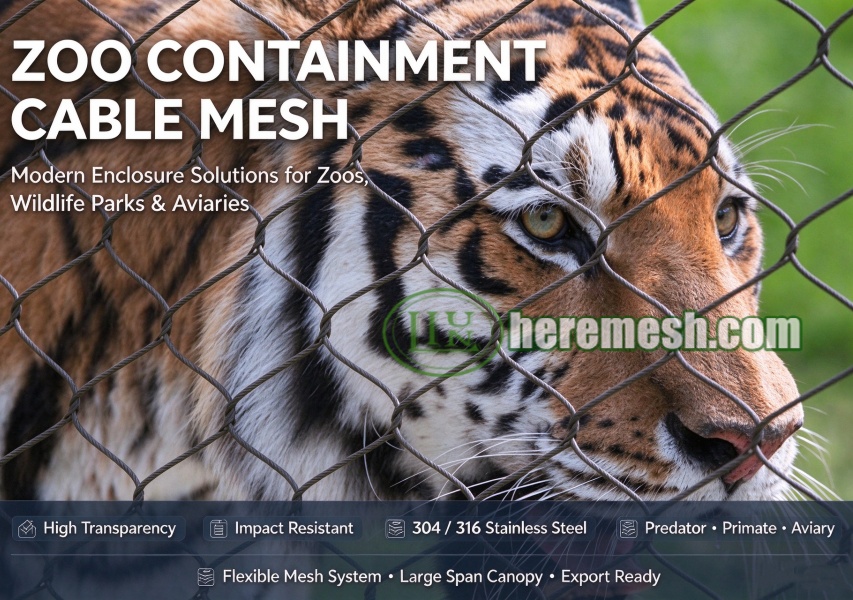
In recent years, the enclosure materials used in newly built or renovated zoos, wildlife parks, and aviaries have been quietly changing. The thick wire mesh and welded wire mesh of the past are being replaced by a more “invisible” material—stainless steel cable mesh. In overseas project specifications, this type of protective mesh is often referred to as “zoo containment cable mesh”, “zoo mesh”, “zoo animal enclosure mesh” and so on.
However, this presents a challenge for buyers. Various stainless steel cable meshes are available at varying prices. Behind these price differences lie significant disparities in material performance, manufacturing processes, and safety ratings. To pick a reliable enclosure for exhibition zones, learn why parks prefer stainless steel cable mesh over old fences.
Why Stainless Steel Cable Mesh Is Preferred for Modern Zoo Enclosures?
Traditional enclosure materials fall into just a few categories: welded wire mesh, galvanized wire mesh, glass, and concrete walls. Each has its own distinct shortcomings.
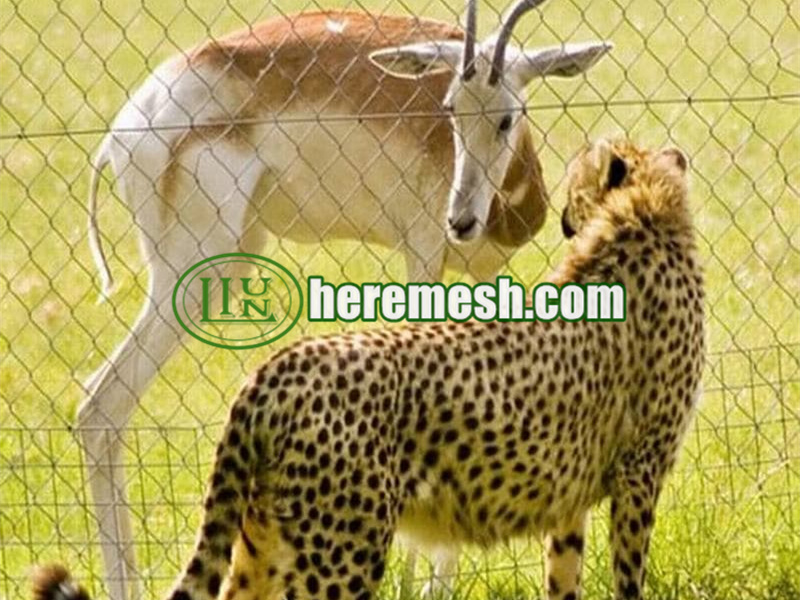
Stainless steel cable mesh addresses precisely these shortcomings of traditional materials. Zoo containment cable mesh is woven or clipped together from multiple strands of stainless steel rope. There are no welded joints, and the entire net is flexible. When an animal collides with the mesh, it undergoes elastic deformation, dispersing the impact energy across the entire mesh. And its frame rather than concentrating it at a single point—a critical feature during high-altitude leaps, lunges, and rutting-season collisions. The mesh has no sharp edges, features a smooth surface, and is easy to rinse and disinfect. The mesh panels typically weigh only 1.1 to 2.5 kilograms per square meter. This makes them well-suited for large-span canopies and retrofits of existing structures. The open area ratio generally exceeds 80%, allowing visitors to see animal behavior through the mesh.
It simultaneously improves animal welfare, the visitor experience, and long-term operational and maintenance costs. It is precisely why it is the preferred choice for both new exhibition areas and the renovation of existing enclosures.
304/316 Zoo Containment Cable Mesh for Predator, Primate and Aviary Exhibits
Material selection is a key factor in product selection. 304 stainless steel contains approximately 18% chromium and 8% nickel and is classified as a general-purpose austenitic stainless steel. For zoo projects in inland areas with typical climates and under normal cleaning conditions, it offers the best value for money. Grades 316 and 316L incorporate an additional 2% to 3% molybdenum, significantly enhancing resistance to chloride ion pitting corrosion. They are suitable for coastal areas with high salt fog, water features, wading bird exhibits, and parks where de-icing salt is spread in winter. Within the same park, different exhibits can certainly use different materials; there is no need for uniformity across the entire park.
Cable Mesh Specifications: Diameter, Construction and Mesh Opening
Regarding rope diameter, common specifications include 1.2 mm, 1.6 mm, 2.0 mm, 2.4 mm, and 3.2 mm, with two structural types: 7×7 and 7×19. The 7×7 configuration consists of seven strands, each with seven wires, resulting in a stiffer cable with higher load-bearing capacity. The 7×19 configuration features finer, more flexible wires, making it suitable for applications requiring a refined appearance and a smooth feel. Mesh sizes range from 20×20 mm to 100×100 mm.
Aviary Exhibit Configuration
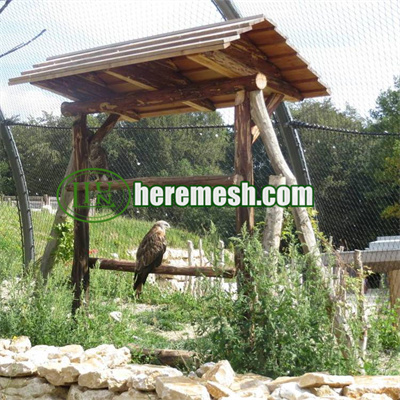
Bird sanctuaries typically use ropes with a diameter of 1.2 to 1.6 mm and mesh openings ranging from 20 × 20 mm to 30 × 30 mm. Since birds are small and pose a high risk of escape, the mesh opening must be smaller than the dimensions through which a small bird’s head and body could pass. Large-span canopies should also be equipped with support cables to prevent the netting from billowing under wind loads. A black oxide finish is recommended to reduce glare that might startle the birds and to prevent glare in visitors’ photographs. For wading bird exhibits, a rope diameter of 2.0 mm is recommended, and 316 stainless steel is advised for its superior corrosion resistance, which reduces replacement costs in the long term.
Primate Exhibit Configuration
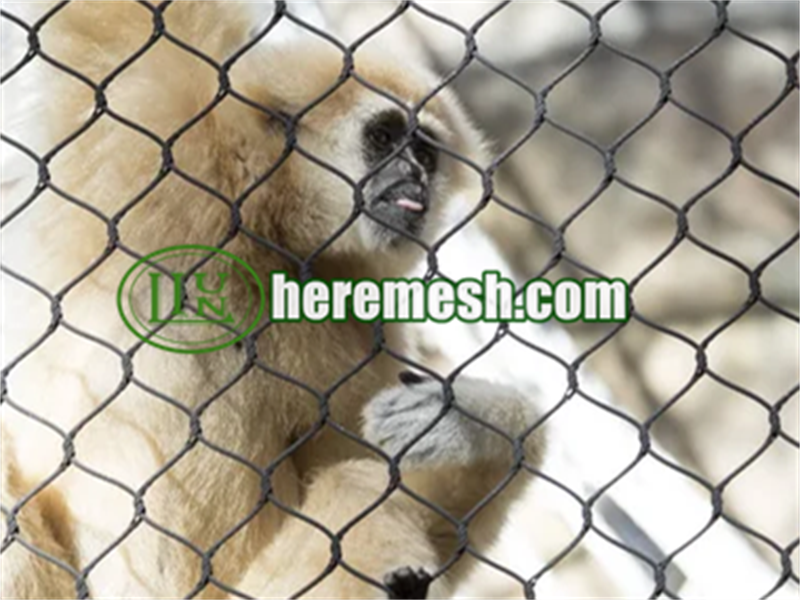
For primate exhibits, a rope diameter of 1.6 to 3.2 mm and mesh openings ranging from 30×30 mm to 51×51 mm are recommended. The focus here is not only on preventing escapes but also on ensuring that animals’ fingers do not get caught when grasping the mesh and that the netting can withstand the dynamic loads caused by repeated climbing and swinging.
Predator Exhibit Configuration
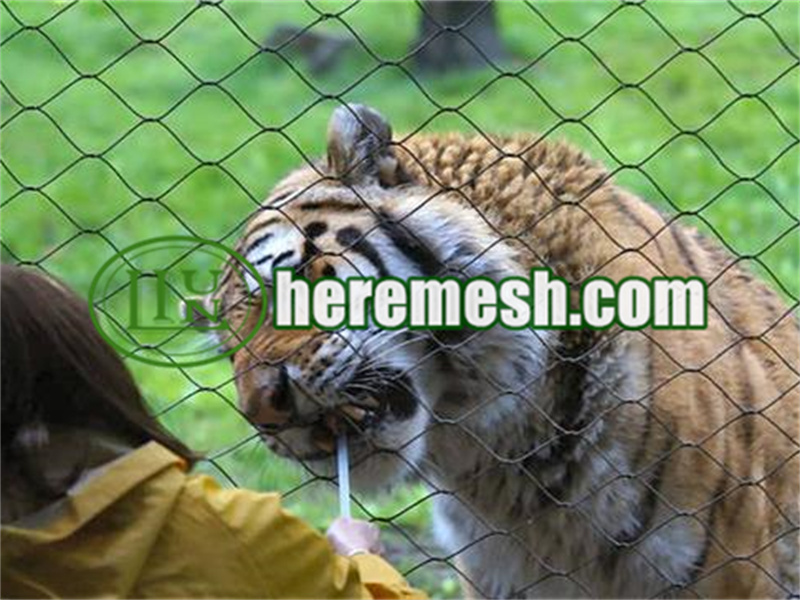
The big cat exhibit area has the highest strength requirements. For tigers, leopards, wolves, and bears, a rope diameter of 2.4 to 3.2 mm, mesh openings ranging from 51×51 mm to 76×76 mm, and a 7×19 wire configuration are typically selected. The frame profiles for these exhibits must be designed to withstand impact loads. They cannot be based solely on the mesh itself. The top must also feature an inward fold to prevent animals from climbing up and over the mesh.
Selection Misconception: Smaller Openings Do Not Equal Safer
A common misconception is that “the smaller the mesh opening, the safer it is.” In reality, excessively small mesh openings significantly increase costs and wind resistance. Conversely, mesh openings that are too large defeat the purpose of protection, as an animal’s head or limbs could become trapped. The correct approach is to determine the mesh opening by working backward from the “smallest part of the target animal’s head or body that could pass through,” while ensuring sufficient visual space for big cats.
Zoo Containment Cable Mesh Purchasing Pitfalls
1. Do not rely solely on verbal assurances regarding material specifications. For the first collaboration, you may request that the supplier provide a material report specifying the steel grade, chemical composition, and mechanical properties.
2. Focus on breaking strength, not just rope diameter. Even for ropes with the same 2.4 mm diameter, the breaking strength can vary significantly depending on whether the construction is 7×7 or 7×19 and the tensile strength of the individual wires. Require suppliers to provide data on the tensile strength of individual wires and the breaking strength of the entire mesh. This is especially critical for predator exhibits.
3. Distinguish between ferrule and woven construction methods. Ferrule construction uses stamped stainless steel ferrules to crimp and secure the intersections, offering high efficiency. However, each ferrule is a potential weak point; be sure to inquire about the ferrule material, crimping process, and anti-loosening measures. Woven construction has no ferrules at the joints, offers greater flexibility, and has a more refined appearance. Neither method is inherently superior. The choice depends on the project budget, aesthetic requirements, and future maintenance capabilities.
4. Inspect the edge finishing. The perimeter of the mesh panels must be properly sealed. There must be no exposed, loose wire ends, as these could cause cuts to both animals and visitors.
5. Assess corrosion resistance based on the actual operating environment. Zoos involve frequent washing, disinfectant solutions, and ammonia-rich environments. Even 304 stainless steel may develop rust spots under these conditions. For areas near water features, wading bird enclosures, and coastal projects, it is recommended to use 316 stainless steel directly.
Advantages of Flexible Zoo Containment Cable Mesh
High Transparency: With an open area ratio typically exceeding 80%, the mesh surface is virtually invisible. Visitors can clearly see the animals’ expressions and movements, which facilitates the observation of their natural behavior. For the animals, their view is not completely obstructed, and they experience less stress from onlookers.
Impact Resistance: When subjected to force, the flexible mesh undergoes elastic deformation, dispersing point impacts across the entire surface. Combined with the tension provided by the frame, this forms an integrated load-bearing system. It outperforms rigid mesh panels when facing attacks by wild animals, objects thrown by visitors, typhoons, and snow loads.
Resistant to Rust: Stainless steel cable mesh has no plating, so there is no risk of rusting once the plating wears off. Its corrosion resistance comes from the material itself.
Long Service Life and Low Maintenance: Under normal conditions, the service life can exceed 20 years. Routine maintenance requires only periodic inspections of tension and ferrules. There is no need for annual painting, zinc replenishment, or mesh replacement, resulting in significantly lower long-term total costs compared to galvanized mesh.
Lightweight and Design Flexibility: With a low dead weight, it places minimal load on roofs and columns, making it particularly suitable for retrofitting existing enclosures. The mesh surface can conform to the curvature of the frame, fitting seamlessly to arched, spherical, sloped canopies, and irregularly shaped exhibit areas—something rigid mesh panels cannot achieve.
Safety features: No sharp edges or protruding welds. The mesh surface provides elastic cushioning, minimizing the risk of injury when animals collide with it. The joints are easy to grip, making them suitable for primate climbing.


Factory Capacity for Large-Scale Production
We have the capacity for large-scale, centralized production and can fulfill orders for large-scale zoo containment cable mesh for overseas zoos. There includes canopies for expansive exhibition areas and full-enclosure systems. With our own large-scale production lines and a constant stock of 304 and 316 stainless steel wire rope raw materials, we are capable of simultaneously scheduling the production of multiple batches of large-area mesh panels. We can ensure the stable delivery of orders spanning thousands of square meters without issues such as insufficient production capacity or project delays.
Our comprehensive quality control system covers the entire production process—from raw material intake, rope strand weaving, and clip fastening to finished product shipment. We verify the rope diameter, mesh opening, and knot tensile strength on a batch-by-batch basis to ensure that all mesh panels in a batch are uniformly specified, free of dimensional deviations, and meet the stringent animal protection standards required for overseas projects.
We also possess well-established international trade capabilities, enabling us to package products in accordance with export standards to prevent deformation or damage to the mesh during long-distance transport. Through partnerships with multiple shipping companies, we minimize freight costs. Our team provides full-cycle project support to ensure the safe and timely delivery of goods.