

Zoo X-tent Ferrule Mesh Project Delivered On Time

Subtle Details of Crane Aviary: Animal Welfare Design of Crane Netting
10/30/2026
Big Cat Enclosure Upgrade, Escape Risk Prevention
The existing protective mesh in the big cat exhibit at a certain zoo had been in use for many years. After prolonged exposure to repeated collisions by leopards, sun and rain, and corrosion from routine disinfection solutions, potential hazards gradually became apparent. These include rusting of the mesh, loosening of joints, and deformation of the mesh. Leopards are powerful and agile, and they have a tendency to continuously test the weak points of their enclosures. Once structural loosening occurs, the risk of escape rises sharply.
The park’s operations and maintenance team fully understood that enclosures for large cats are far more than mere barriers. Animal enclosures serve multiple purposes, including ensuring animal safety and protecting visitors. Once the project kicked off, the procurement and technical teams carried out comparisons on different enclosure materials. The options covered welded wire mesh, expanded metal mesh, standard woven steel wire rope mesh, and x-tent ferrule mesh. They ran sample tests and assessed different solutions from several key aspects. The evaluation criteria covered impact resistance, long-term stability, animal-friendliness and ease of later maintenance.
After repeated screening, the park chose x-tent ferrule mesh for its leopard exhibit renovation. When a leopard collides with the mesh, the entire surface absorbs and dissipates the force rather than resisting it locally and tearing. The mesh openings remain stable without shifting, and the gaps do not widen under tension. Furthermore, individual sections of the netting can be replaced without compromising the integrity of the entire structure during maintenance.
Upon receiving the order, the production department immediately scheduled production, prioritizing the fulfillment of this order. The manufacturing process strictly employs highly corrosion-resistant 316 stainless steel wire ropes, secured with reinforced clamps. Tensile strength and mesh precision are randomly inspected panel by panel throughout the process. This ensures every panel meets load standards to withstand continuous impacts from leopards. After the order is shipped, we will continue to monitor the progress of the exhibit renovation. And then we will respond promptly to address any customer feedback.
What is the strongest wire mesh?
When selecting wire mesh, the first question many buyers ask is:”Which mesh is the strongest?” Many people’s initial instinct is that the harder, thicker, and less bendable the mesh is, the stronger it must be. However, in the context of enclosures for large predators at zoos, this perception is actually a significant misconception. Strength cannot be defined solely by hardness. Truly reliable protective strength is a comprehensive capability composed of three factors: tensile load-bearing capacity, fatigue resistance, and joint stability. Welded wire mesh relies on weld points for fixation, and these weld points are stress concentration points. Under continuous impact and vibration, they are prone to weld separation and cracking. Expanded metal mesh has high hardness but virtually no cushioning capacity. It is prone to brittle fracture under high-speed impact, and once damaged, it results in large-scale failure.
The core advantage of x-tent ferrule mesh lies in its structural logic. It consists of multiple strands of fine steel wire twisted into a rope, with metal ferrules securing the intersections to physically lock the mesh openings in place. When a leopard collides with the mesh at high speed, the impact force is dispersed outward along the multiple strands of the rope. The kinetic energy is absorbed through the rope’s flexible deformation, rather than having a single point bear the entire impact alone. Unlike rigid mesh, it will not break immediately from a single impact.
Therefore, the definition of “strongest” must be discussed in the context of specific scenarios. In terms of pure static load-bearing capacity, thick steel plate mesh has higher numerical values. However, when faced with repeated, instantaneous dynamic impacts, the stainless steel x-tent ferrule mesh used in predator exhibits is the choice with superior overall protective capabilities. Its strength lies in its resistance to being breached in a single impact and its ability to withstand rapid failure even under long-term, repeated impacts.
How long does x-tent ferrule mesh last outdoors?
How long will a x-tent ferrule mesh last outdoors? This is the second most common question asked by customers.
The service life of a ferrule mesh is primarily determined by three factors: material grade, operating environment, and routine maintenance. 304 stainless steel ferrule nets are suitable for general outdoor settings with dry climates, low salt content, and infrequent disinfection. Under standard operating conditions, their typical service life ranges from 15 to 20 years. In contrast, 316 stainless steel, which contains added molybdenum, offers significantly enhanced resistance to chloride ion corrosion, making it better suited for zoo environments. Exhibition areas are frequently rinsed with clean water and sprayed with disinfectants. Animal excrement adheres over long periods. And in coastal regions, there is the added exposure to sea salt fog. In such harsh environments, 316 ferrule mesh can typically provide stable service for over 20 years.
At the same time, it’s important to maintain an objective perspective: stainless steel is not completely rust-proof. The passivation film serves as its protective layer; if high-concentration disinfectants or fecal stains remain on the surface for extended periods, the passivation film will gradually break down, leading to the slow appearance of rust spots. Durability is not an inherent, permanent property of the material, but rather the result of a combination of material quality, manufacturing processes, and regular maintenance. Choosing high-grade materials essentially extends the safety lifespan and reduces the likelihood of short-term renovations or replacements; from a long-term operational and maintenance perspective, this approach is actually more cost-effective.

Is stainless steel x-tent ferrule mesh safe for big cats?
Safety is the primary consideration when selecting enclosure mesh for zoos.
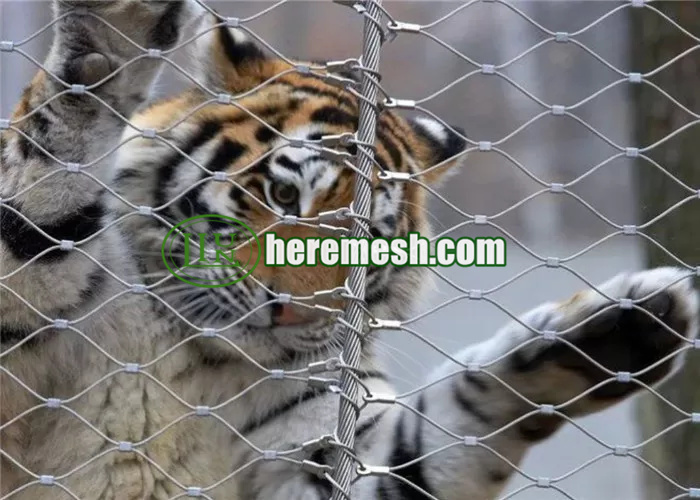
The safety of enclosures for large felines involves two aspects. First, preventing animals from breaking through the enclosure and escaping. Second, ensuring that the enclosure structure itself does not cause harm to the animals—what is commonly referred to in the industry as animal welfare. Many enclosure materials can effectively contain animals but are prone to causing scratches or entrapment injuries.
Stainless steel ferrule mesh offers advantages in both of these areas. The rope is made of multiple strands of steel wire twisted together. Its surface has been polished and passivated, resulting in a smooth finish. Unlike welded wire mesh, stainless steel x-tent ferrule mesh does not have the burrs or sharp weld slag commonly found in welded mesh. When the ferrule process is properly executed, the joints are flat with no protruding sharp edges. This minimizes the risk of scratches to a leopard’s claws or fur when it climbs, rubs against, or gnaws on the mesh.
In terms of escape prevention, the ferrule joints prevent the mesh openings from stretching. As long as the mesh opening is appropriately matched to the leopard’s body size, the openings will not become larger over time. Additionally, the rope mesh is open and transparent, avoiding the creation of a closed-off, oppressive visual barrier. From a behavioral perspective, overly enclosed enclosures can easily exacerbate stress in animals and induce stereotypical behaviors. The open-weave rope netting allows cheetahs to observe their surroundings normally, reducing anxiety and balancing containment needs with animal welfare.
Of course, the material itself is only the foundation; ensuring safety ultimately depends on proper mesh opening design, standardized installation and securing, and regular inspections. Rope netting serves as a safety measure, not a universal guarantee of safety.
What gauge ferrule mesh is best for leopard enclosure?
There is no single standard answer for what size ferrule mesh is suitable for a leopard exhibit. The key is to match the animal’s size, the magnitude of the impact force, and the exhibit’s location.
Unlike tigers and jaguars, a leopard’s strength does not lie in biting or crushing, but rather in the instantaneous impact generated by high-speed sprints. In standard design, 3.2mm steel wire rope is typically preferred for the leopard viewing area, as it offers better visibility and does not obstruct visitors’ view. At exhibit corners, entrances and exits, and high-impact zones where animals frequently collide, thicker steel wire rope is used to provide greater impact resistance. The standard mesh opening is 51mm × 51mm, which prevents the leopard’s head and limbs from becoming trapped while maintaining good visibility.
Many buyers fall into a common misconception: blindly choosing thicker wire ropes under the assumption that “thicker equals safer.” However, excessively large rope diameters increase the structure’s rigidity and reduce its flexibility, which actually weakens its shock-absorbing capacity and significantly drives up costs. A reasonable approach is to design the system in zones: reinforcing high-risk areas while ensuring a clear view in general viewing areas, thereby striking a balance between safety, aesthetics, and budget.
The essence of selection lies in adapting to the behavioral characteristics of leopards, rather than simply pursuing the highest possible numerical specifications. Discussing specifications without considering the actual usage scenario can easily lead to either excessive investment or inadequate protection.


Can x-tent ferrule mesh be repaired on site?
Whether a fence can be repaired on-site directly determines the duration of the risk window following a failure. If a damaged fence must be completely dismantled and sent back to the factory for repair, it means the exhibition area will need to be closed for an extended period—requiring animal relocation and construction barriers—which will simultaneously increase both risks and costs.
A key feature of ferrule mesh is its ability to support localized on-site repairs. Welded wire mesh is difficult to repair in situ once damaged. Ferrule rope netting, however, is different. The ferrule rope netting features a modular structure. If a single rope segment or ferrule is damaged, only the affected component needs to be replaced. And the ferrule can be re-secured using a specialized crimping tool. There is no need to dismantle the entire netting structure.
However, we must view this advantage rationally. On-site repairs do not mean that just anyone can perform them at will; repair personnel must be familiar with the structure and adhere to crimping standards to ensure that the tensile strength of the repaired ferrules meets specifications. Otherwise, the repair site could become a new weak point. Zoos can stock a small supply of spare steel cables and matching ferrules to address minor to moderate damage. If extensive impact causes multiple connection points to fail, a comprehensive inspection and assessment are still required.
The value of on-site repairs lies in reducing emergency response time and quickly mitigating risks when minor damage occurs, eliminating the need to wait for lengthy custom manufacturing and shipping cycles, and providing zoos’ operations and maintenance teams with an additional layer of flexibility.
Conclusion
X-tent ferrule mesh relies on its flexible structure to disperse impact forces, uses locking nodes to secure the mesh boundaries, employs corrosion-resistant materials to extend the safety lifespan, and reduces operational and maintenance burdens through its ability to be repaired in specific areas.
No single fencing material is flawless. Steel mesh offers high rigidity but lacks cushioning, while welded wire mesh is low-cost but prone to weld failure. In the specific context of large feline exhibits, the ferrule rope netting represents the optimal solution achieved through comprehensive balancing of these factors.
This leopard enclosure renovation project starts with the identification of safety hazards and goes through extensive comparisons and evaluations. It culminates in the final selection of the rope netting solution and also serves as a reference for similar facilities. The safety of enclosures for large predators cannot be judged solely by whether they can contain animals in the short term. We must also consider whether they can withstand repeated impacts over many years, whether they minimize harm to the animals, and whether damage can be quickly addressed when it occurs.
The ultimate goal of protection has never been simple isolation. It is to find a stable balance between safety, animal welfare, and long-term operations and maintenance, continuously creating reliable and humane living boundaries for captive wildlife.